Strategists/NT
The Cartographer
This profile speaks to you as if you are an INTJ. If you have not taken the test yet, your own report adds your exact scores, your Mindprint and your compass region.
- Seal
- 図zu, map, plan
- Share of people
- 3.1%1
- About
- 1 in 33
- Family
- Strategists
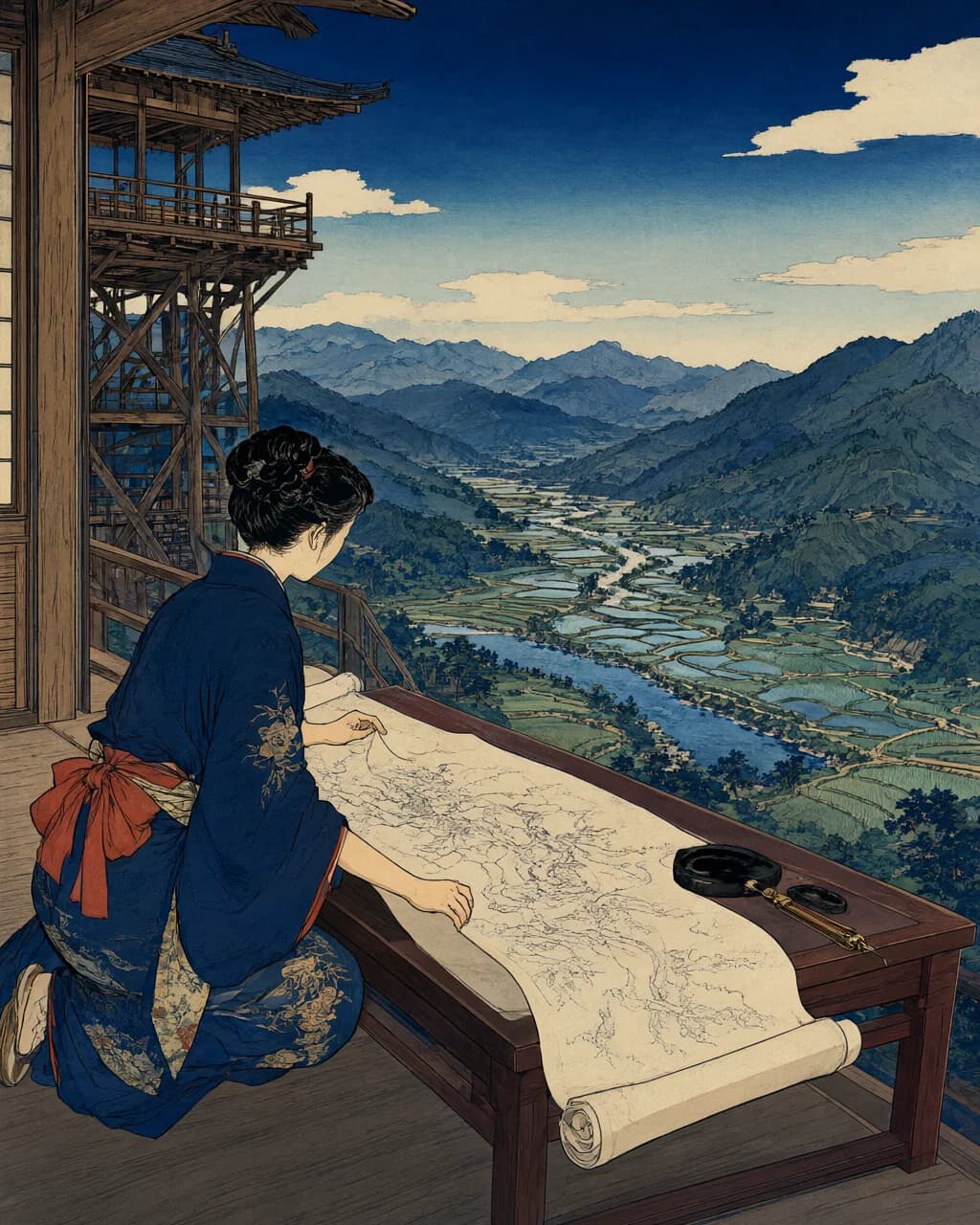
How Cartographers see the world
- Strategic
- Independent
- Analytical
- Decisive
- Private
- Far-sighted
You tend to see where a situation is heading before the route is obvious, then build a plan sturdy enough to get there. You are usually private and independent, and you care more about whether an idea will last than whether it is popular.
- LeadNi Foresight
Your Lead function is Introverted Intuition (Foresight), and it works quietly in the background. You take in a meeting, a project or a conversation, and some time later a single picture of what is going on settles into place, often before you can list the steps that got you there. You tend to read situations by their trajectory rather than their surface: what this decision will cost in three years, which small problem will become the big one. Where some people like to keep options open, you narrow them until one interpretation holds, then trust it enough to plan around it.
- SupportTe Efficiency
Extraverted Thinking (Efficiency) is your Support, and it turns that picture into something that works. You decide by asking what will actually produce the result: which steps, in what order, backed by what evidence. You are quick to cut whatever does not serve the goal, from redundant meetings to well-meant suggestions, and you will take charge when a plan is clearly failing, though you would usually rather design the plan than run the room. To others you can come across as calm, reserved and surprisingly blunt. Because your conclusions arrive fully formed, people may mistake a decision you weighed for weeks for one made on the spot.
- Relief and EdgeFi ConvictionSe Presence
Your Relief, Introverted Feeling (Conviction), supplies a few private principles you will not trade away, though you seldom explain them. Your Edge is Extraverted Sensing (Presence), attention to the physical world as it is right now. The central tension for Cartographers is between the map and the ground: it is easy to trust the picture in your head over the facts in front of you, or to forget sleep and meals while a plan has your attention. Maturity often looks like testing your vision early against real feedback, and letting the present count as more than a step toward the future.
Strengths
Long-range foresight
You are good at spotting the second and third consequences of a choice: the policy that will create a loophole, the shortcut that will force a rebuild. Colleagues often realize months later that you flagged the problem early.
Plans that hold
You turn a vision into steps with clear checkpoints, and you build a fallback for the step most likely to fail. Your plans tend to hold up under pressure because you have already rehearsed, privately, most of the ways they could go wrong.
Independent judgment
Your views come from evidence, and rank, popularity or habit carry little weight with you. You will question a long-standing practice if its reasoning no longer holds, and you are hard to talk out of a well-supported conclusion by pressure alone.
Sustained deep focus
Given a hard problem and a long, uninterrupted stretch of time, you can hold many moving parts in mind at once. You often come back from a quiet afternoon with a design that already accounts for most of the awkward cases.
Lasting loyalty
Your commitment shows in follow-through more than in words. Once someone has earned your trust, you remember what matters to them, speak up for their work when they are not in the room, and keep promises they forgot you made.
Blind spots
Locking in too early
Because a conclusion feels obvious once it clicks, you can stop listening too soon. Facts that do not fit the picture may get explained away, and others can feel you had decided before they finished speaking.
Feedback that lands cold
Your feedback tends to arrive as a short, exact list of what is wrong, often in writing and without mention of what is working. You mean it as respect for the work, but without your reasoning it can read as dismissal.
Going it alone
You often prefer solving a problem yourself to explaining it, which can leave others out of decisions that affect them. By the time you share the plan, people may resist it mainly because they had no part in shaping it.
Missing the present
Absorbed in a long-range problem, you can overlook what is happening right now: a colleague's growing frustration, a deadline this week, your own tiredness. The future can feel more real than today, until today catches up.
How your mind works
In Jungian type theory, INTJ leads with Introverted Intuition (Foresight) and balances it with Extraverted Thinking (Efficiency).
Lead: Foresight (your home base)
Introverted Intuition works below the surface, folding many observations into a single insight or vision. People who lead with it often know where a situation is going before they can explain why, and they think in implications, symbols and long arcs. It is the process behind strategic vision, sudden clarity and a feel for what something really means.
Support: Efficiency (your balancing partner)
Extraverted Thinking applies logic to the outer world. It sets goals, defines steps, measures progress and cuts what does not work. People who lead with it make decisions readily, give clear instructions and prefer criteria that anyone can check. It is the process behind effective management, systems that scale and the confidence to make the call.
Relief: Conviction (your playground)
Introverted Feeling measures everything against an inner compass of values. It asks “does this feel right to me?” and is hard to argue out of its answer. People who lead with it value authenticity, empathize deeply with individuals and keep much of their emotional life private. It is the process behind integrity, loyalty to a cause and the courage to stand apart.
Edge: Presence (your growth edge)
Extraverted Sensing points attention fully outward at the present moment: colors, textures, movement, openings and risks as they happen. People who lead with it notice what just changed in a room, react quickly and physically, and learn best by doing. It is the process behind sharp reflexes, a strong aesthetic eye and the knack of seizing a moment before it passes.
- NiLeadForesight · Introverted Intuition
- TeSupportEfficiency · Extraverted Thinking
- FiReliefConviction · Introverted Feeling
- SeEdgePresence · Extraverted Sensing
At work
Your best work usually comes from long, private preparation followed by fast, decisive execution. You want to see the whole problem, choose your own approach and be judged on results, not visible busyness. Small teams of capable, candid people suit you better than large ones, and you tend to need little social contact to stay motivated. Hand you a hard, open-ended problem and real authority to solve it, and the result is often a system that keeps running long after the project that created it.
Fields people of this type often enjoy
- Business strategy
- Systems engineering
- Scientific research
- Law and policy
- Investment analysis
- Urban planning
- Medicine
- Data science
You do your best work when
- You own a hard problem from first analysis to final design
- Goals are clear and the method is left to you
- Evidence outweighs seniority in decisions
- You get long, uninterrupted blocks of time to think
What drains you
- Meetings that end without a decision or an owner
- Procedures that persist only out of habit
- Constant interruptions while you are trying to think
- Status games that matter more than the quality of the work
Type describes preferences, not abilities. People of every type succeed in every field.
In relationships
You tend to show care by investing in someone's long-term good: researching the decision they are stuck on, planning the trip down to the train times, checking in on a goal they mentioned months ago. You let few people in and take your time doing it, but those who make it through usually stay. You rarely put feelings into words, and you may assume your actions speak clearly enough. Often they do, though the people you love may still need to hear it said.
What you need from people close to you
- Time alone without having to justify it
- Plain speaking instead of hints you must decode
- Respect for your competence and independence
- Patience while you work out what you feel
As a partner
In a close partnership you tend to be steady, candid and devoted. You think ahead about the shared future, from where you will live in five years to how to split the work fairly, and you would rather fix a recurring problem than argue about it twice. You need a partner who respects your solitude and does not read it as rejection. Saying the affectionate thing out loud, as well as doing it, often matters more than you expect.
As a friend
As a friend you are usually selective and loyal. You prefer seeing two people regularly to seeing twenty occasionally, and you show up with substance: a well-researched recommendation, a frank read on a situation, help with a problem they have been circling for weeks. You may go quiet for a month without anything having changed. Friends who understand that will find you exactly where they left you.
Talking with a Cartographer
Share these with the people around you.
- Lead with the conclusion and the evidence, and keep the warm-up short.
- Send questions or documents ahead so they can think before the meeting.
- Ask for their view directly; in a group they may not volunteer it.
- Explain the reasoning behind a change rather than citing rules or rank.
Under stress
- 1. StrainNi
Your Lead, Foresight, works overtime: more of your usual style, applied less flexibly.
- 2. GripSe
If pressure keeps building, your Edge, Presence, can take over in clumsy, out-of-character ways.
- 3. Recovery
Rest and the ways back listed here help you return to your usual balance.
When pressure builds, you tend to withdraw, tighten control and grow curt, explaining less and deciding more on your own. If the strain lasts for weeks, your Edge, Extraverted Sensing (Presence), can grab the wheel in clumsy ways. You might overdo food, screens or shopping in a way that feels unlike you, fixate on small flaws in your surroundings, or act on impulse and regret it. The far-sighted planner turns into someone snagged on every irritating detail of the moment.
Common triggers
- Being made to follow a plan you think is flawed
- Chaos or incompetence you have no power to fix
- Too much noise, clutter or sensory input for too long
- Having your judgment overruled by rank instead of reasons
Ways back to balance
- Take real solitude, with nothing to plan and nothing to decide
- Do something hands-on and absorbing, like gardening, building or a long swim
- Write the problem out until the larger pattern comes back into view
- Talk it through with one trusted person who will not rush you
Room to grow
Small, specific practices that tend to help people of this type most.
Show your reasoning early
Share the half-formed picture before it hardens. Walk one or two people through the steps that led you there and ask what they would change. It feels slower, but it catches errors you cannot see alone and earns support you would otherwise have to win later.
Hunt for the counterexample
When a vision clicks, write down one fact that would prove it wrong, then go and look for it. Before committing resources, ask the person most likely to disagree for their strongest objection, and take notes without rebutting.
Name what you value
Your Relief, Introverted Feeling (Conviction), shapes many of your choices without ever being said. When you make a significant decision, add one sentence about the principle behind it. People follow a plan more readily when they can see what you care about.
Practice being present
Build in regular time for things that only work in the moment: cooking without a recipe, a pickup game, a walk with no destination. Exercising your Edge, Extraverted Sensing (Presence), on purpose makes it less likely to ambush you under stress.
Common misconceptions
MYTHCartographers are cold
Your feelings tend to be private rather than absent. Introverted Feeling (Conviction) gives you firm loyalties and moral lines, and a betrayal or an injustice may affect you far more than anyone sees, simply because you process it alone.
MYTHCartographers think they are always right
You hold conclusions firmly because you worked hard to reach them, not because you assume you cannot be wrong. Show you better evidence and you will often change your mind quickly, sometimes faster than people who argued more loudly.
MYTHCartographers plan every detail of their lives
Strategy and day-to-day logistics are different skills, and you may be much stronger at the first. You can map out a long-range direction with care while improvising dinner and losing track of your keys. Extraverted Sensing (Presence), the function that handles the here and now, is your Edge.
How common Cartographers are
How often you will meet INTJs, and how common each of their four letters is. Common or rare, no type is better than another.
3.1%
of people are Cartographers (INTJ): about 1 in 33, making it the 5th least common type of sixteen.
Their four letters among everyone
- E Extraverted 38.8%61.2% Introverted I
- N Intuitive 31.5%68.5% Observant S
- T Thinking 52.1%47.9% Feeling F
- J Judging 52.5%47.5% Perceiving P
Their family, the Strategists
- Keepers SJ42.4%
- Improvisers SP26.1%
- Seekers NF19.2%
- Strategists NT12.3%
All sixteen types, most common first
- ISTJAnchor17.6%
- ISFJSteward10.6%
- ISTPTroubleshooter9.4%
- ESTJQuartermaster8.0%
- ENFPCatalyst7.5%
- ISFPArtist6.7%
- INFPWayfarer6.4%
- ESFJHearthkeeper6.3%
- ESFPSpark5.1%
- ESTPScout4.9%
- INTPCodebreaker4.5%
- INTJCartographer3.1%
- ENTPTrailblazer3.0%
- INFJLamplighter2.9%
- ENFJTorchbearer2.3%
- ENTJCaptain1.8%
Source: MBTI Global Step I results for a US sample of 3,578 adults, matched to US census targets (Schaubhut et al., 2018). Shares differ between countries, age groups and samples.
The other Strategists
Strategists combine big-picture perception with logical decision-making. They want to know how things work, why they work, and how they could work better, and they hold themselves and others to high standards of reasoning.



The map of all sixteen
Where Cartographers sit among the other fifteen types. Neighboring cells differ by a single letter.
Tinted cells are one letter away from INTJ. Columns pair perception and decisions; rows pair energy and structure.
Source: MBTI Global Step I results for a US sample of 3,578 adults, matched to US census targets (Schaubhut et al., 2018). Shares differ between countries, age groups and samples.
Is INTJ really you?
Reading a profile is a good start. The test shows where you actually land on each scale, including the close calls a four-letter code hides.
1 Share of a US sample of 3,578 adults who took the MBTI Global Step I assessment, recruited to match census targets (Schaubhut, Thompson, Morris and Arneson, 2018). Shares differ between countries, age groups and samples; treat them as rough guides.